
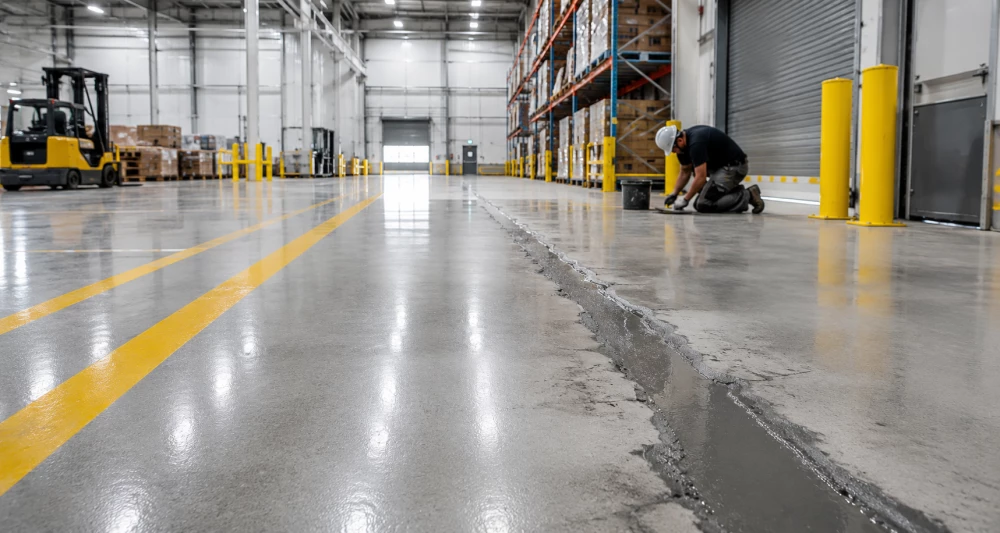
Warehouse Floor Repair
Get in TouchDamage to a warehouse floor can become progressively worse under forklifts, pallet trucks and other material-handling equipment.
We provide warehouse floor repair for damaged concrete floors, joints and high-traffic areas. Repairs can target individual defects or form part of a wider warehouse floor refurbishment.
Get a Warehouse Floor Repair Quote
What Warehouse Floor Damage Can We Repair?
Warehouse floors can develop different types of damage depending on the slab, traffic and previous maintenance.
Repairs can be carried out for:
Cracked concrete
Damaged floor joints
Joint edge deterioration
Spalled concrete
Potholes
Surface damage
Worn traffic routes
Uneven localised areas
Failed previous repairs
Damaged resin flooring
The appropriate repair method depends on what has caused the damage and how the repaired area will be used.
Warehouse Concrete Floor Repairs
Concrete warehouse floors are subjected to repeated loading throughout their working life.
Forklifts and pallet trucks frequently travel along established routes, concentrating wear on relatively small areas of the slab.
Damage is particularly common around doorways, intersections, loading areas, racking aisles and other locations where vehicles repeatedly turn or cross joints.
Repairing these areas can restore a more suitable surface without automatically resurfacing the entire warehouse.
Damaged Warehouse Floor Joints
Joints are vulnerable areas within industrial concrete floors.
Hard-wheeled warehouse traffic repeatedly crosses the joint and can damage the concrete edges on either side.
Once the edges begin to break down, continued traffic can cause the damaged area to become progressively larger.
Joint repairs can involve removing loose or failed material, preparing the repair area and rebuilding the damaged edges with a repair system appropriate to the joint and expected traffic.
Joint Edge and Arris Repairs
The arris is the concrete edge immediately adjacent to a floor joint.
When an arris breaks down, forklifts and pallet trucks no longer cross a clean, level joint. Instead, their wheels repeatedly strike the damaged edge.
Warehouse floor joint repair can restore these deteriorated sections and create a smoother transition for warehouse traffic.
The type of joint should be identified before repair because joints designed to accommodate movement need to continue functioning correctly after the work is completed.
Cracked Warehouse Floors
Not every concrete crack requires the same repair.
Cracking can occur because of shrinkage, movement, impact or other conditions affecting the slab.
Before filling a crack, its condition should be assessed to establish whether it appears stable or whether movement is likely to continue.
The repair material and method can then be selected around the characteristics of the crack rather than simply filling the visible surface.
Warehouse Floor Pothole Repair
Localised concrete failure can create depressions and potholes in warehouse traffic routes.
These defects can interfere with the movement of forklifts, pallet trucks and pedestrians.
Repair typically involves cutting or preparing the damaged section, removing weak material and reinstating the area with an appropriate repair product.
The completed repair should integrate with the surrounding floor and be suitable for the traffic expected to pass over it.
Spalled Concrete Floor Repairs
Spalling occurs when sections of the concrete surface or edges break away.
Within warehouses, this can develop around joints, cracks, impact points and heavily trafficked areas.
Leaving loose or deteriorated material in place provides a poor base for a repair.
Damaged concrete therefore needs to be removed back to an appropriate substrate before the area is reinstated.
Repairs Along Forklift Routes
Warehouse floor damage is often concentrated rather than evenly distributed.
Main forklift routes can experience significantly more traffic than storage areas elsewhere in the building.
Common problem locations include:
Aisle intersections
Vehicles repeatedly cross and turn within a confined area.
Doorways
High volumes of traffic pass through the same narrow route.
Loading areas
Forklifts repeatedly collect and deposit loads.
Racking aisles
Material-handling equipment follows established routes between storage locations.
Turning points
Vehicle steering and repeated wheel movements concentrate wear.
Repair priorities can therefore be based on the areas having the greatest effect on warehouse operations.
Uneven Warehouse Floor Repairs
Sudden changes in floor level can affect both pedestrian and vehicle movement.
The appropriate repair depends on the cause and extent of the uneven area.
Local surface defects may be suitable for repair or levelling, while more significant slab movement can require further investigation before a surface repair is attempted.
A repair compound should not be used to disguise an underlying structural problem that has not been identified.
Repairing Failed Resin Flooring
Existing warehouse resin floors can eventually develop local failures.
This can include peeling coatings, worn sections, impact damage or areas where the resin has lost adhesion to the substrate.
The failed material should be removed before the underlying concrete is assessed.
Local resin repairs can then be matched to the surrounding flooring where practical, or the repair can form part of a wider recoating or resurfacing project.
Repair or Resurface?
A damaged warehouse does not necessarily require a completely new floor.
Local repairs can be appropriate where defects are confined to individual joints, cracks or traffic areas and the surrounding floor remains serviceable.
More extensive refurbishment may make sense where:
Damage occurs throughout the warehouse
Large areas are heavily worn
An existing coating is failing extensively
The surface is producing excessive concrete dust
Numerous previous repairs are deteriorating
A new flooring finish is required across the facility
Assessing the complete floor helps determine whether targeted repairs or wider resurfacing is the more appropriate approach.
Warehouse Floor Repair With Minimal Disruption
Taking large warehouse areas out of operation can interfere with storage and distribution.
Where the repair method and site layout allow, work can be organised into smaller zones.
Individual joints, aisles or damaged sections can be isolated while other parts of the facility remain available.
The repair programme needs to account for the curing requirements of the selected material before forklifts, pallet trucks or pedestrians are allowed back onto the repaired surface.
Repairing Floors Before Resin Installation
Floor repairs are often completed as part of the preparation for a new resin flooring system.
Cracks, damaged joints and deteriorated concrete should be addressed before the main floor finish is applied.
A typical refurbishment sequence can involve:
Inspecting the existing warehouse floor
Identifying cracks, joints and damaged areas
Mechanically preparing the substrate
Completing required concrete repairs
Preparing repaired sections
Installing the specified resin flooring system
Allowing the floor to cure before reopening
This provides a more suitable substrate for the subsequent flooring installation.
Warehouse Floor Repair Contractors
We carry out warehouse floor repairs throughout for storage facilities, distribution centres and logistics buildings.
Projects can range from repairing a small number of damaged joints to addressing cracks, potholes, spalling and widespread deterioration across larger warehouse floors.
Send us photographs showing the damaged areas, the approximate size of the repair and details of the traffic using the floor. This helps establish the likely repair requirements before the work is assessed in more detail.